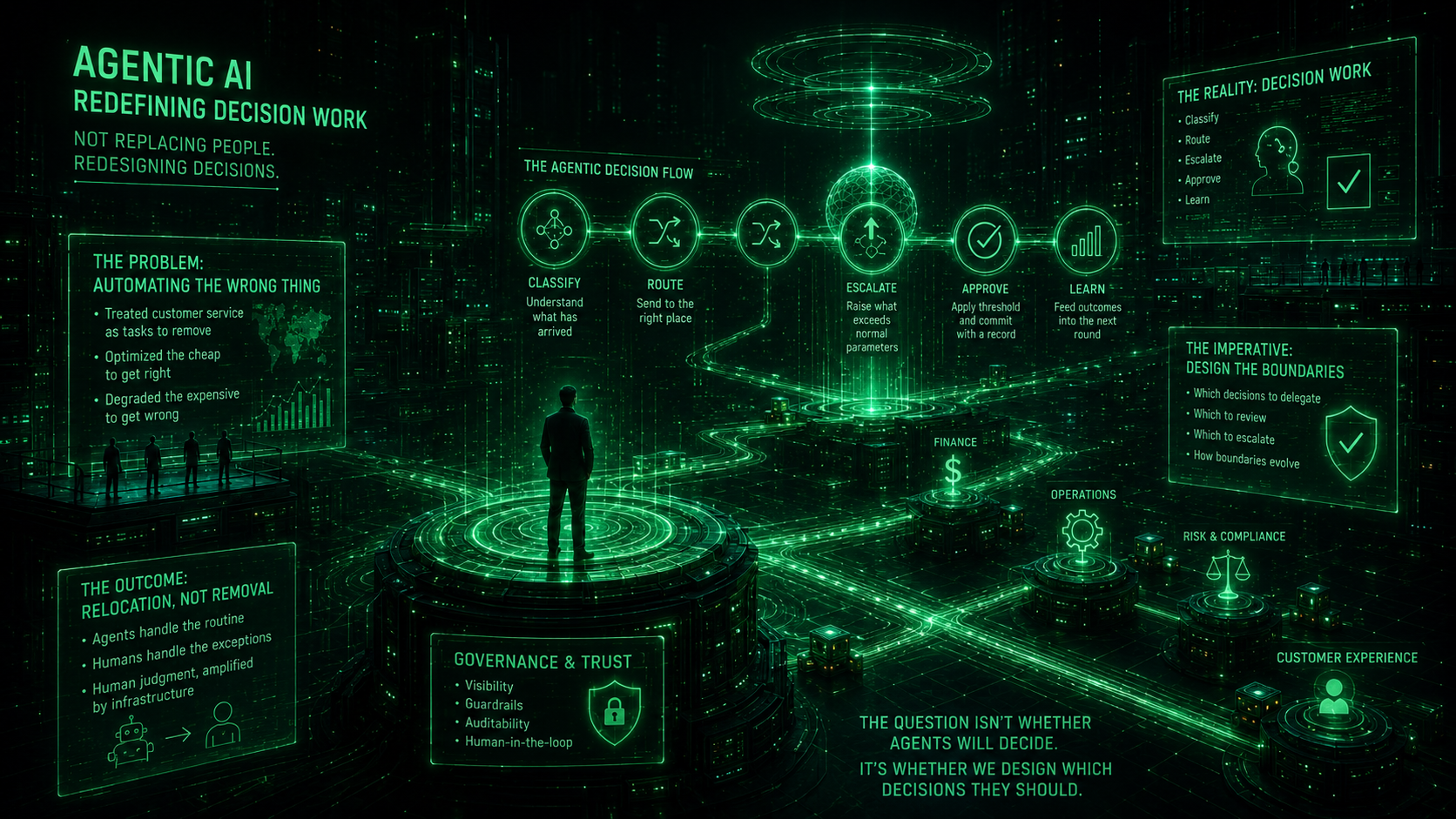
The age of agentic AI has arrived. The organizational infrastructure required to govern it has not, and the cost of that gap is beginning to show.
We have been asking the wrong question. Across industries and executive suites, the dominant inquiry has centered on technological capability: which AI systems perform best, which platforms offer the most complete integration, which benchmarks most reliably predict production outcomes. These are not unreasonable questions, but they are insufficient ones, because the constraint that is now limiting the realization of AI value is not located within the technology itself. It is located within the organizations attempting to deploy it.
The emergence of agentic AI systems marks a genuine discontinuity in the relationship between organizations and the technologies they operate, and we believe that discontinuity is not yet being treated with the seriousness it deserves. Unlike conventional automation, which improves the execution of defined tasks, agentic systems interpret high-level objectives, decompose complex goals into coordinated subtasks, operate across platforms, APIs, and data sources simultaneously, and adapt their behavior in response to changing inputs, without requiring human prompting at each step. The difference between this and what came before is not one of degree. It is one of kind. And the organizational models most companies currently operate were not designed with this kind of technology in mind.
WHAT “AGENTIC” ACTUALLY MEANS
Traditional AI systems are, in their essential character, reactive: an input enters, an output is produced, and the system waits. Agentic AI is proactive in a more demanding and more consequential sense. Given an objective of sufficient generality, such as optimizing a procurement pipeline or resolving a class of customer complaints at scale, an agentic system will construct a plan, execute across relevant tools and systems, evaluate intermediate results against the stated goal, and revise its approach accordingly, without pausing to ask whether the approach is the right one. The system behaves less like sophisticated software and more like a distributed workforce operating under a mandate it has interpreted for itself.
This is not a theoretical capability. In September 2025, MIT Professional Education launched the Applied Agentic AI for Organizational Transformation program, led by Professor John R. Williams and Dr. Abel Sanchez, reflecting the growing need for leaders to understand how autonomous agents reshape business processes, infrastructure, governance, and organizational decision-making. The program’s animating thesis is not that organizations lack access to capable AI. It is that they lack the governance architecture, the decision frameworks, and the organizational coherence required to direct that capability toward meaningful, controllable ends.

“Just as cloud reshaped the economics of IT, agents will redefine business operations.”
DR. ABEL SANCHEZ, EXECUTIVE DIRECTOR, MIT GEOSPATIAL DATA CENTER
THE EFFICIENCY TRAP
McKinsey has estimated that generative AI alone could contribute up to $4.4 trillion annually to the global economy, a figure striking enough to appear in virtually every board-level discussion of AI strategy. What appears considerably less often in those discussions is the condition attached to that projection: the value accrues only to organizations that know how to implement these systems effectively. The evidence suggests that many organizations still struggle to do so effectively.
When confronted with a powerful new capability, the managerial instinct is to reach for familiar metrics, speed of task completion, cost per unit, throughput per headcount, and the gains these metrics capture are real. We do not dispute them. But optimizing discrete tasks while leaving the underlying organizational architecture unchanged is a strategy that generates local improvements while concealing systemic vulnerabilities, because agentic systems, unlike the automation tools that preceded them, do not respect the boundaries of departments or functions. They operate across the organization, interpreting objectives and triggering cascading consequences that cross every internal boundary at once. Where those objectives are imprecisely specified, where accountability is distributed without being clarified, and where no one has established the conditions under which autonomous judgment should yield to human review, the result is not enhanced efficiency. It is fragmentation operating at a speed and scale that makes it genuinely difficult to diagnose, let alone correct.
QUESTIONS NO ONE HAS ANSWERED
The transition from automation to orchestration surfaces a category of governance questions that most organizations have not previously been required to answer, because the systems that make them urgent did not previously exist. Who has the authority to define the objectives that autonomous systems are instructed to pursue? By what process are AI-generated outputs validated before they are permitted to influence consequential decisions? Where, precisely, does accountability sit when an action is the product of machine judgment operating within parameters set by a human who is no longer present in the decision loop? And how does an organization override a system that is executing at a pace no human approval chain can match?
These are not engineering problems amenable to technical solutions. They are organizational design problems that require deliberate institutional responses, and many organizations risk encountering these questions after deployment, when the cost of answering them is already higher.
What has become clear, both from the research literature and from the reported experience of practitioners navigating these transitions, is that agentic AI does not generate organizational dysfunction where none previously existed. It amplifies dysfunction that was already present, and it does so with a thoroughness and at a speed that renders the underlying problems far more visible and far more expensive than they were before. Communication gaps that were manageable at human pace become consequential at machine pace. Fragmented decision-making that was merely inefficient becomes a source of systemic inconsistency. Misaligned execution that once affected a single process now scales across every customer interaction, every supply chain decision, and every financial process that the system has been authorized to touch.
“Agentic AI does not create organizational dysfunction. It amplifies existing dysfunction with unprecedented efficiency.”
COHERENCE AS COMPETITIVE ADVANTAGE
We want to be precise about where the strategic opportunity lies, because we think it is frequently mislocated. The advantage in the age of agentic AI will not accrue to the organizations that acquire the most capable systems, or that deploy them most rapidly, or that invest most heavily in technical infrastructure at the expense of organizational readiness. It will accrue to organizations that have done the harder, slower work of becoming what we would describe as organizationally legible: coherent enough, in their governance, their decision frameworks, and their accountability structures, that capable AI systems can actually be directed toward meaningful and verifiable objectives.
A legible organization is one in which the objectives given to autonomous systems are genuinely clear, because the leadership has done the prior work of defining them with sufficient precision to survive implementation. It is one in which outputs can be validated, because standards for what good looks like have been established before the machines begin producing at scale. It is one in which accountability can be assigned when outcomes fall short, because ownership has been defined with enough specificity to remain meaningful after the fact. In an organization with this kind of coherence, agentic AI ceases to be a source of institutional risk and becomes instead a connective layer that links strategy to execution, tightens feedback loops, and accelerates organizational learning in ways that are embedded in the system rather than dependent on particular individuals.
The competitive advantage of the coming decade will belong to organizations that built this coherence deliberately, not to those that assumed the technology would supply it.
THE EDGE CASES ARE REAL
We would be irresponsible not to acknowledge the risks with the same directness we have applied to the opportunities. Speed without direction is genuinely dangerous at machine scale, and the failure modes of agentic systems operating under misaligned objectives are not analogous to the failure modes of conventional software. When agentic systems are coordinating actions across supply chains, customer interactions, and financial processes simultaneously, the cost of an objective that was imprecisely specified, or an override condition that was not anticipated, is not a missed deadline. It is a cascade that may be difficult to trace, and considerably harder to reverse, than any failure mode most organizations have previously needed to manage.
The material costs extend beyond the organizational. Professor John R. Williams has observed that hyperscalers are already consuming tens of terawatt-hours annually to run AI infrastructure, placing pressure on power grids that were not designed with this demand profile in mind and generating questions about energy governance that remain without settled answers. The ethical and legal dimensions are similarly unresolved: courts have not established clear frameworks for assigning liability when an autonomous process causes harm, and most organizations have not done so either, which means the gap between what these systems can do and what the institutions around them are prepared to govern remains, for the moment, very wide.
The organizations best positioned to navigate this transition will not be those pursuing every new capability as it emerges. They will be those that have learned to ask the slower, harder questions: whether their governance structures are adequate to direct what they are building, whether their accountability frameworks can absorb the decisions that autonomous systems will increasingly be making on their behalf, and whether they can maintain strategic coherence as the scale and complexity of their AI deployments continues to grow.
These are leadership questions, not technology questions. And the evidence is accumulating that the organizations which treat them as such, before deployment rather than after, will be the ones that determine what the next decade of organizational performance looks like.